How to Write Your Own Wedding Vows: A Simple Editorial Guide
Photo: PINTEREST
In the classic film The Princess Bride, the grand, dramatic church scene reminds us how movies love to treat weddings like theater. We are used to seeing couples stand in front of a giant crowd, speaking long, poetic words to each other, a trend made even more famous by reality television shows like Love is Blind. For a long time, this highly emotional, public exchange of personalized vows was seen as a purely American tradition. In contrast, European weddings traditionally relied on the quiet, steady weight of established legal or religious texts – words spoken to an official or a priest, rather than a speech delivered to the room.
Today, however, the global wedding industry has seen these regional boundaries soften. Modern couples everywhere are moving away from rigid scripts, choosing instead to bring a deeply personal element to the altar. Yet, the real shift isn't about making a grand, dramatic statement for the guests. In the most elegant contemporary ceremonies, personalized vows have become something much quieter: a private agreement that just happens to be spoken out loud, where everything else in the space temporarily fades into the background.
A Different Way to Think About Structure
When people struggle with how to write wedding vows, it is rarely due to a lack of deep feeling. More often, they simply do not know how to organize those feelings on a blank page. Without a clear plan, it is easy to fall into the trap of using cliché phrases or avoiding the writing altogether. A helpful approach is to treat your writing like a simple map, utilizing a clear wedding vow template that moves naturally through four clear steps.
1. The Opening Address
Begin by acknowledging the exact moment, not your entire history. This is where many vows get crowded – they attempt to condense a whole relationship into a single paragraph. Instead, the most powerful opening is disarmingly direct: you are speaking to the person right in front of you, at this exact time, in this specific setting. Shift the focus away from "since the day we met" and ground it firmly in the here and now. This instantly removes the pressure of storytelling.
2. The Specific Memory
A vow gains immediate meaning the moment it stops being abstract. Rather than listing milestones or grand adjectives, choose a single, precise memory that still feels completely real to you. It doesn’t have to be a big thing. The most resonant choices are often quiet things – a snippet of an old conversation, a simple gesture, a small detail that only makes sense in hindsight. The goal here is recognition. You are not trying to prove your relationship to the guests; you are simply identifying what makes it yours.
3. The Real Commitments
This is the heart of the text. The strongest vows avoid poetic ideals in favor of real, everyday behavior – decisions you will actually make on an ordinary Tuesday afternoon, not just on a wedding day. Selecting three to five commitments is the ideal balance; fewer can feel incomplete, while more tends to blur the focus.
The quality of this section relies entirely on being specific. A generic promise to "always support you" does not carry the weight of describing how you intend to support them when they are overwhelmed, uncertain, or quietly pulling away. True honesty lives in contrast. The best commitments acknowledge reality: how you will choose to behave not only when your lives are easy, but more importantly, when they are difficult.
4. The Closing Line
End cleanly, choosing a clear direction over a dramatic finish. The final sentence should land like a definitive point placed at the end of a long, carefully considered thought. It does not need to summarize your entire emotional landscape; it merely needs to confirm that what you have just spoken is permanent. Here, keeping it simple becomes the ultimate form of elegance.
Photo: PINTEREST
Keeping Tone Honest and Unforced
The most memorable vows sit comfortably between absolute clarity and quiet intimacy. When exploring sentimental vows for him, men often find immense strength in quiet, understated specificity, focusing on practical everyday commitments. Conversely, curating deep wedding vows for her often involves identifying the subtle, invisible ways a partner has altered the geometry of her world and redefined her understanding of home.
A common mistake is over-writing; when language becomes too decorative, it begins to dilute the actual meaning of the words. A second pitfall is over-generalization, where sentences rely too much on words like "always" or "forever" without anchoring those massive concepts to anything real. A modern approach favors language that feels entirely natural and unperformed.
Integrating funny wedding vows certainly has a place at the altar, but only when it reveals something genuinely accurate about your bond. It should never interrupt the emotional importance of the moment; rather, it should sharpen it. A single, well-placed line can signal deep familiarity far more effectively than an entire paragraph of sentiment. The difference lies entirely in intent – humor works when it comes from mutual recognition, not from an attempt to entertain the room. It should feel like an inside joke that the crowd just happens to catch.
Photo: PINTEREST
Meaning Without Traditional Frameworks
For couples choosing non-religious ceremonies, the spoken vows carry an even greater responsibility. When working with modern wedding ceremony scripts that lack inherited liturgy, your chosen language must hold the entire weight of the moment. Looking at high-end, contemporary wedding vow examples shows us that meaning is no longer borrowed from the past, but built through absolute attention. What replaces tradition is not emptiness, but deliberate intention. What replaces tradition is not emptiness, but deliberate intention – the clarity of what is being promised and the discipline of not over-explaining what can simply be felt.
This mindset naturally embraces short wedding vows as a form of luxury. There is a persistent misconception that longer vows mean deeper love, but the opposite is almost always true. Brief vows require a level of editing that longer texts avoid. They force you to identify what actually matters and discard the extra noise. When spoken aloud, they hold their shape beautifully, landing cleanly without losing emotional tension. Sixty to ninety seconds is often more than enough to carry something monumental.
Ultimately, vows are not a writing contest or a theater piece. They are a rare instance where words are asked to carry the full weight of a relationship without decoration or defense. Everything else in the wedding can be styled and designed. The vows are the one element that must be purely chosen.
Photo: PINTEREST
How do we ensure our vows align in tone and length if we want them to remain a surprise until the ceremony?
Alignment rarely comes from comparing words. It comes from agreeing on the shape of what you’re both building. Before writing, decide on a simple framework together: roughly how long you want to speak (150–250 words tends to hold attention well), the basic structure (a short opening, one grounded memory, a few specific commitments, and a closing line), and an overall tone – whether you want it to feel minimal, emotional, or slightly more conversational.
This way, the vows remain personal and surprising, but still feel like they belong in the same emotional world. For couples thinking beyond just vows and into the full ceremony design, BrideLifestyle.com’s Wedding planners and Wedding agenciespartners help shape the overall narrative of the day in a way that feels cohesive, not staged.
We are planning a secular celebration but want the exchange to feel elevated and significant. How do we build that atmosphere?
In a secular ceremony, the atmosphere is not created by tradition, but by attention to detail. What makes the moment feel significant is often what is removed rather than added: slower pacing, silence between sentences, and space for words to actually land. Nothing needs to be rushed. Nothing needs to be filled.
A strong celebrant is central to this – they hold the rhythm of the room so the vows don’t feel like isolated speeches, but part of a wider emotional arc. Explore BrideLifestyle.com’s Wedding hosts & celebrants and Wedding venues partners to find spaces and voices that naturally support that kind of presences.
Photo: PINTEREST
Should we read our vows from our devices, or is there a more aesthetically polished alternative?
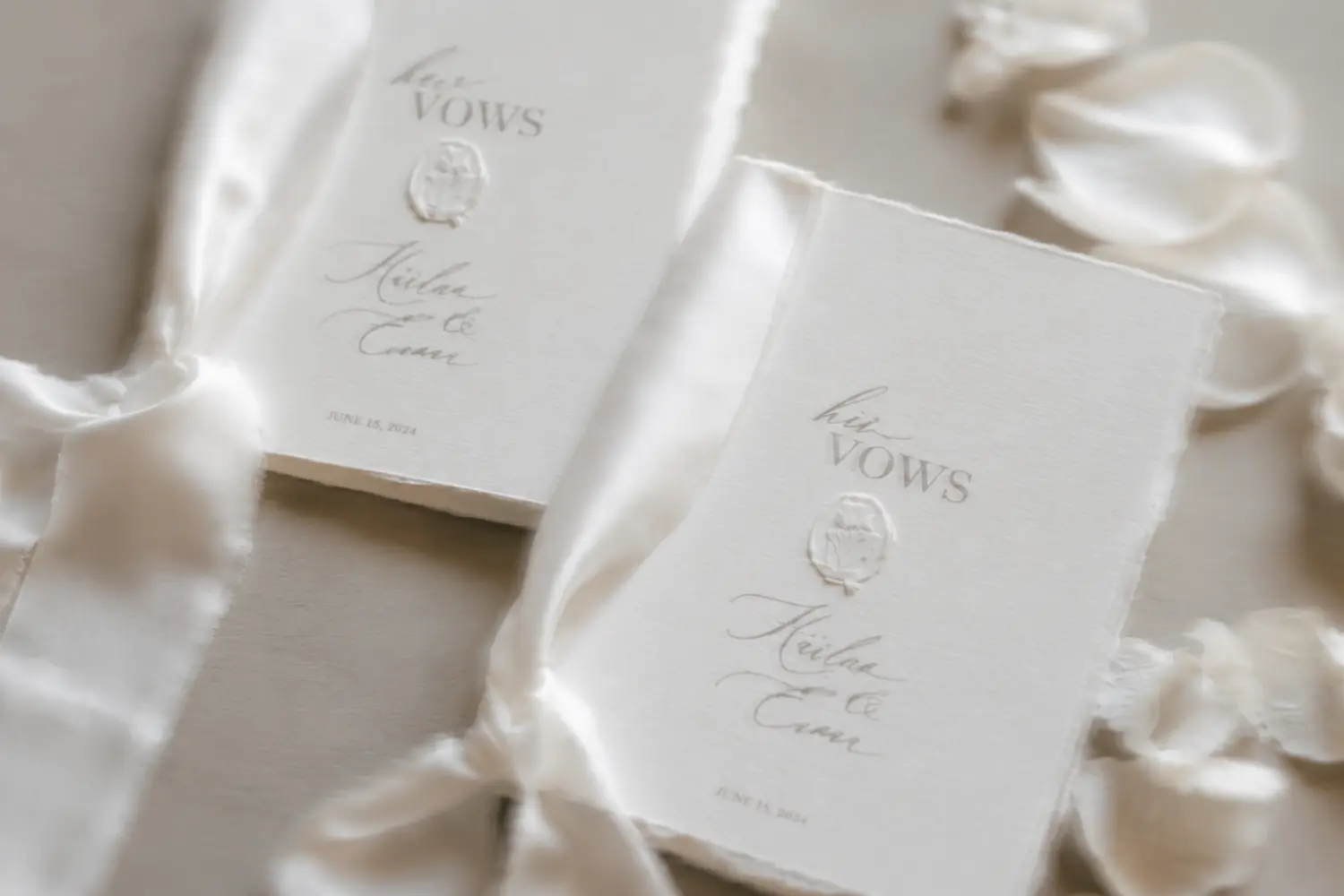
Devices tend to pull attention out of the moment. Even subtly, they change the texture of what’s happening – light, posture, eye line. A more intentional choice is to print or handwrite your vows on paper that feels aligned with the rest of your wedding design. Some couples use simple handwritten cards, others create small archival vow booklets that later become keepsakes.
It also changes how the vows are spoken. Holding something physical slows you down in a natural way – it makes pauses feel normal instead of awkward. For the visual side of the moment, BrideLifestyle.com’s Wedding stationery & invitations, Wedding photographers, and Wedding video partners can help ensure the details and emotion are preserved without distraction.
What is the best way to practice our delivery without desensitizing ourselves to the emotion of the text?
You don’t need to rehearse the vows into familiarity – you just need to make them speakable. Reading them out loud a few times in a quiet space is usually enough. The focus should be on flow and breath, not memorization or performance. You’ll quickly hear where something feels too dense or unnatural when spoken.
If anything starts to feel emotionally flat through repetition, it’s often a sign it’s been over-edited rather than under-practised. The strongest lines tend to hold their meaning even when you hear them more than once. For couples refining timing, ceremony structure, and the wider emotional pacing of the day, BrideLifestyle.com’s Wedding planners and Luxury weddings partners offer a more holistic way to shape the experience.
This website uses cookies to improve the user experience and optimize its performance. By continuing to use this website, you agree to the use of cookies on this website.
Read more

 share
share


.webp)
.webp)
.webp)
.webp)


