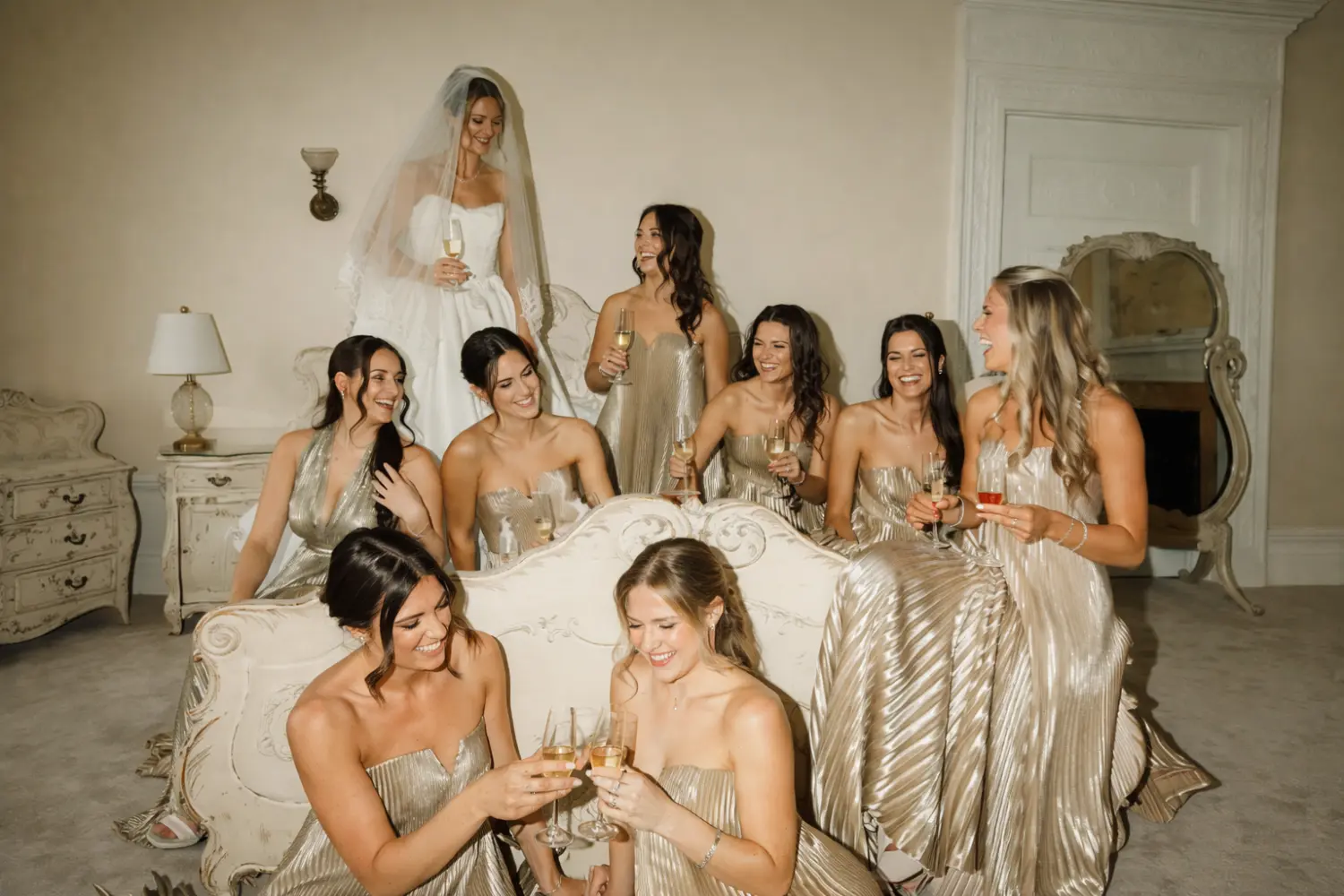
The moment it happens, it feels like a collective victory. Your best friend holds up her hand, the light catches the ring, and your eyes instantly fill with tears. There is the inevitable crescendo of screaming, the impulsive jumping, and the overwhelming euphoria that feels remarkably like winning the lottery. We spend our lives wishing for our friends to find their ultimate person – even if the arrival of that soulmate means gently accepting that you are no longer her exclusive partner for life.
It is a beautiful, cinematic milestone. And it usually reaches its peak of pure fun when she asks you to be her maid of honor. Whether the question arrives hidden inside an artisan cupcake, embossed on a velvet-lined keepsake box, or written in gold calligraphy, the proposal feels monumental. The "maid of honor proposal" is becoming practically as staged and emotionally saturated as the actual engagement in today's bridal culture.
It is easy to get swept up in the romance of the title. We have been conditioned by a lifetime of pop culture to view the role through a hyper-glamorous lens. We think of the curated satin robes, the front-row seat to the vows, and the elegant reception toast.
Think back to that classic episode of Friends where Monica is torn between choosing Rachel or Phoebe. Initially, they are so blinded by the prestige of the role that they launch into a fierce, highly competitive audition process to prove their worth. It is only after the dust settles that the comedic facade slips, and they realize the staggering weight of the maid of honor expectations they have actually volunteered for.
Because here is the unvarnished reality that no cute cupcake inscription can prepare you for: the groom’s primary responsibility is to show up, look immaculate, and commit to a lifetime of unconditional love. He represents the destination. You represent the infrastructure that gets the bride there intact. The groom doesn’t get to say "I do" until the maid of honor has quietly orchestrated the universe that makes the moment possible. This is the deep, maid of honor survival guide that pop culture left out.
Navigating the Relational Reset
The most profound challenge of becoming a maid of honor is not logistical; it is psychological. Once you’re engaged, the unwritten rules of your friendship are instantly, and often shockingly, recalibrated. For years, your relationship has been built on a foundation of egalitarian reciprocity – an equal exchange of vulnerabilities, spontaneous late-night phone calls, and mutual emotional support.
When a wedding enters the picture, that equilibrium temporarily dissolves. The bride’s cognitive capacity is naturally, and by necessity, hijacked by a complex emotional and financial enterprise. For the maid of honor, this can trigger an unexpected, unspoken sense of relational mourning.
When a wedding is a luxury affair, with multi-day events and a guest list with significant social standing, the pressure for the bride is immense. A study published in the Journal of Family Issues found that major life transitions that involve public ritual performance and substantial financial investment are associated with significantly increased interpersonal stress and temporary cognitive overload in close female dyads . The bride is often operating under a state of chronic sensory processing fatigue; she simply does not have the emotional bandwidth to ask about your career, your dating life, or your internal world.
Understanding this shift is the first step toward self-preservation. It is crucial to realize that her temporary self-absorption is a symptom of structural pressure, not a reflection of diminished affection. To remain mindful, an elite maid of honor must compartmentalize her own expectations. This is the period to seek emotional reciprocity from other areas of your support network, allowing you to show up for the bride not as a needy participant, but as a grounded, emotionally sovereign anchor.
Photo: PINTEREST
Beyond the Checklist: Redefining the Maid of Honor Duties
When you look up a standard maid of honor duties list online, it usually outlines the same mechanical tasks: host the bridal shower, track the RSVP list, hold the bouquet during the vows, and bustle the dress. These are the initial operational requirements but the real weight of the role is in the unspoken text.
Studies from the Association for Psychological Science and other sociological studies on wedding customs show that weddings serve as intense social performances in which friend groups and families are compelled to unite. From private to public, the dynamic changes. Consequently, a hidden part of your maid of honor checklist includes acting as a silent emotional buffer.
You become a human shock absorber for family politics. When you bring together divorced parents, estranged siblings, old collegiate rivalries, and complex in-law dynamics under the roof of a remote estate or a historic European villa, friction is almost inevitable. Your true duty is to create an invisible, impenetrable perimeter around the bride’s mental space, ensuring that no administrative chaos or interpersonal toxicity penetrates her consciousness.
Photo: PINTEREST
The Art of Becoming Invisible
There is another truth that nobody really talks about: if you are an exceptional maid of honor, your work will largely go unnoticed, because its entire purpose is to allow someone else to remain uninterrupted.
Over the past few years, weddings have changed profoundly. Couples are no longer solely interested in creating beautiful events that photograph well; they are becoming increasingly invested in how those events feel while they are happening. The atmosphere, the pace of the day and the emotional experience itself have become just as important as the flowers, the table settings or the location. Brides no longer want to arrive at the end of the evening and realize they spent their entire wedding answering questions, making decisions and managing other people's emotions. They want to remember how it felt to be fully immersed in one of the most significant days of their lives.
This is where the role of a maid of honor quietly transforms. It stops being a ceremonial title and becomes an act of care. The role is no longer about being the loudest person in the room or the one who organizes the best bachelorette weekend. In reality, it requires an extraordinary amount of restraint. It means noticing things before they become problems, understanding when to intervene and, perhaps most importantly, recognizing when to simply sit beside the bride and allow her to exist without needing anything from her.
Photo: PINTEREST
Luxury wedding planner Nancy Michali sees this dynamic unfold at every celebration she creates. "The biggest challenge a maid of honor faces on the wedding day is balancing emotional presence with practical responsibility. She is often the bride’s closest confidante, absorbing emotions, calming nerves, and offering reassurance while also helping everything run smoothly. It’s a role that requires both empathy and composure."
That balance is far more difficult than it sounds. By its very essence, friendship is mutual. You have most likely experienced both successes and setbacks in equal measure for the majority of your adult life. Both individuals share the same emotional space, according to an unspoken understanding. Weddings temporarily suspend that agreement. For one season of life, the bride inevitably becomes the centre of an enormous gravitational field.
At this point, another perspective adds important emotional nuance. As wedding planner Cátia from Ode Stories explains, the true difficulty is not external coordination but internal absorption:“The biggest challenge a maid of honor faces is often managing emotions that are not her own. Weddings naturally bring together expectations, family dynamics, last-minute changes, and heightened emotions, and the maid of honor frequently finds herself absorbing some of that energy. The challenge is learning how to be supportive without becoming overwhelmed by the responsibility of keeping everyone happy.”
Her insight reframes the role entirely. The maid of honor is not simply assisting the bride; she is quietly filtering emotional noise so that the bride can remain untouched by it.
A great maid of honor understands this instinctively and does not interpret it personally. She recognizes that this is not the moment to seek validation from the friendship itself, but to become a steady presence within it. There is a certain generosity required in allowing someone else to occupy the center of the story without asking to be seen yourself.
Perhaps that is what people misunderstand most about the role. Being a maid of honor is not about adding yourself to the wedding experience. It is about removing obstacles from it.
Photo: PINTEREST
Emotional Protection in Real Time
Many women enter the role believing they need to solve every problem. In reality, the bride rarely needs solutions by the time the wedding day arrives. Most decisions have already been made months earlier. What she needs is protection from unnecessary stimulation. Weddings, even the most intimate ones, can be surprisingly overwhelming environments.
There are photographers moving through rooms, family members asking questions, timelines being adjusted in real time and countless small logistical decisions happening simultaneously behind the scenes. Even when everything is running beautifully, there is a tremendous amount of invisible activity taking place around the couple.
Ode Stories expands on this beautifully, describing the role as one of gentle filtration rather than intervention: “One of the most valuable ways a maid of honor can help the bride stay grounded is by becoming a gentle filter rather than a problem-solver. Not every question, comment, or minor disruption needs to reach the bride. When timelines become intense, mindfulness often comes from protecting the couple's emotional space.”
In practice, this can be something as subtle as redirecting a question before it reaches the bride, or as simple as a shared moment of silence before walking into the ceremony space. Presence, not productivity, becomes the real form of support.
Nancy Michali explains that one of the most valuable things a Maid of Honor can do is protect the bride's energy. "When timelines become intense, she can help by filtering unnecessary questions, minimizing distractions, and gently reminding the bride to stay focused on what truly matters. With a planner discreetly overseeing logistics behind the scenes, the maid of honor is free to focus on emotional support and helping the bride remain present in the moment."
This distinction is important because wedding planners and maid of honors are often mistakenly expected to perform the same function. They do not. A planner protects the structure of the day, while a maid of honor protects the emotional experience of living it. One oversees logistics; the other safeguards presence. When those two roles work together seamlessly, the bride experiences something remarkably rare in modern life: she is able to surrender.
Surrender, perhaps, is one of the greatest luxuries left. In our everyday lives, we are constantly required to make decisions. We answer messages, manage schedules, organize our homes, solve problems and anticipate the needs of everyone around us. Weddings can easily become an extension of that pattern if nobody consciously interrupts it. An exceptional maid of honor understands that her responsibility is not to add another layer of management but to gently remove it.
Laura Somma, CEO of LS Events and founder of The Wedding Privé, offers a perspective that may be the most accurate description of the role we have encountered. "The biggest challenge isn't logistics, it's emotional translation. A great maid of honor reads the bride'senergy before she even has to ask, and quietly absorbs the chaos so the bride never has to carry it. That invisible labor of love is the real job."
Emotional translation is a beautiful way to describe what is often impossible to articulate. Brides do not always know what they need at the moment. Sometimes they become quieter than usual. Sometimes they become overstimulated. Sometimes they need five minutes alone before they realize it themselves. The women who excel at this role are usually those who understand their friends deeply enough to notice the slightest shift in their energy before anybody else does.
Photo: PINTEREST
This requires presence more than action. We have become accustomed to believing that being helpful means being productive, but weddings often ask us to do the opposite. Sometimes being helpful means standing silently beside someone while they gather themselves before walking down the aisle. Sometimes it means offering a glass of water without asking. Sometimes it means redirecting a conversation away from the bride before she even hears the question.
Laura Somma often describes the maid of honor as the bride's"heartbeat regulator", and there is something profoundly moving about that phrase. "When timelines tighten, panic is contagious; calm has to be too. I always say: the maid of honor should become the bride’s heartbeat regulator. A hand on the shoulder, a slow breath, a whispered “we have time” even when you don’t. Presence, not solutions, is what grounds a bride in those final minutes."
It is remarkable how much influence one person's energy can have over an entire room. Human beings borrow emotions from one another all the time, often without realizing it. A single anxious person can create a sense of urgency that spreads quickly, but the opposite is equally true. One calm presence can soften an entire atmosphere.
Perhaps this is why the smallest gestures become so significant. A hand squeeze before the ceremony begins. Eye contact across a crowded room. A quiet reminder to breathe. These moments are never captured in the wedding album, yet they often become the memories that endure.
Photo: PINTEREST
Structure Turns into Emotion
Among all elements of a wedding, the civil ceremony is often the most misunderstood. It is legally necessary, structurally simple, and emotionally underestimated. Yet within its simplicity lies enormous potential for intimacy.
Ode Storiesdescribes this transformation with remarkable clarity: “One of the most effective ways to make a civil ceremony feel deeply romantic is to create intentional moments of storytelling. Whether through personal vows, a carefully chosen reading, or a reflection on the couple's journey, these elements transform a wedding ceremony into an emotional experience.”
What makes these moments powerful is not their scale, but their sincerity. A civil ceremony becomes unforgettable not because it is grand, but because it feels truthful.
When emotion is allowed to enter even the most structured part of the wedding day, something shifts. The law becomes symbolic. The formal becomes personal. And what could have been administrative becomes deeply human.
Photo: PINTEREST
Presence as the Final Luxury
Perhaps the most overlooked truth about being a Maid of Honor is that success is measured in absence rather than presence. If everything is done correctly, no one notices the effort. The bride simply feels safe, held, and unburdened.
There is a quiet sophistication in this kind of care. It does not demand attention, recognition, or validation. It simply creates space for something else to exist fully.
And long after the wedding ends, when photographs have been archived and dresses stored away, what remains is not the schedule or the seating plan. It is the memory of how the day felt. And often, somewhere inside that feeling, there is someone standing just outside the frame, making sure nothing disturbed it.
Because years later, the bride will not remember whether the ceremony started three minutes behind schedule. She will not remember where someone accidentally placed a seating card or whether one candle burned out too early.
And if she felt those things, it is very likely that someone was quietly standing beside her, protecting that experience all along.
Photo: PINTEREST
What is the Maid of Honor actually responsible for on the wedding day?
Most confusion begins with expectation overload. While the maid of honor is often described as the bride’s “right hand,” in reality her role is far more emotional than operational. Her most important responsibility is to remain present, grounded, and emotionally attuned to the bride – not to manage timelines or coordinate logistics.
In well-orchestrated weddings, those responsibilities are carried by professionals who quietly ensure everything flows seamlessly behind the scenes, allowing the bride and her closest person to remain fully immersed in the experience rather than absorbed by it.
Is a Maid of Honor expected to attend every pre-wedding event?
This is one of the most frequently searched and debated questions today, especially among bridesmaids balancing work, travel, and financial constraints. The truth is that expectations vary widely depending on the scale and style of the wedding, but there is no universal requirement to attend every single event.
What matters most is clarity between the bride and her maid of honor. When expectations are communicated early, it allows the role to remain joyful rather than stressful – and prevents emotional misalignment later in the process.
One of the most sensitive topics in modern weddings is financial pressure. Searches around maid of honor costs have increased significantly, reflecting a growing awareness that the role can quickly become financially overwhelming if expectations are not clearly defined.
In reality, spending varies dramatically depending on location, wedding style, and bridal party structure. The healthiest approach is transparency – discussing budgets early so the role remains sustainable and does not strain personal finances or friendships.
What is the most important emotional role of a Maid of Honor?
Beyond any practical task, the modern maid of honor is increasingly understood as an emotional stabilizer. She is often the person who intuitively reads the bride’s energy, absorbs stress before it escalates, and quietly restores calm when the emotional intensity of the day peaks.
This emotional labor is subtle but powerful – it is less about solving problems and more about holding presence, especially in the final hours before the ceremony when emotions naturally heighten.
How do you protect friendship boundaries when the pressure becomes too much?
This is one of the most important modern shifts in bridal culture. Many maid of honors today experience emotional burnout not because of the wedding itself, but because expectations are often assumed rather than discussed. The healthiest dynamics emerge when boundaries are communicated early, clearly, and without guilt.
A strong bridal experience does not come from one person doing everything – it comes from a network of support, where emotional roles are shared and professionals handle structure and execution. This allows the friendship itself to remain at the center of the experience, rather than becoming defined by pressure.
This website uses cookies to improve the user experience and optimize its performance. By continuing to use this website, you agree to the use of cookies on this website.
Read more

 share
share


.webp)
.webp)
.webp)
.webp)
.webp)
.webp)
.webp)
.webp)
.webp)
.webp)